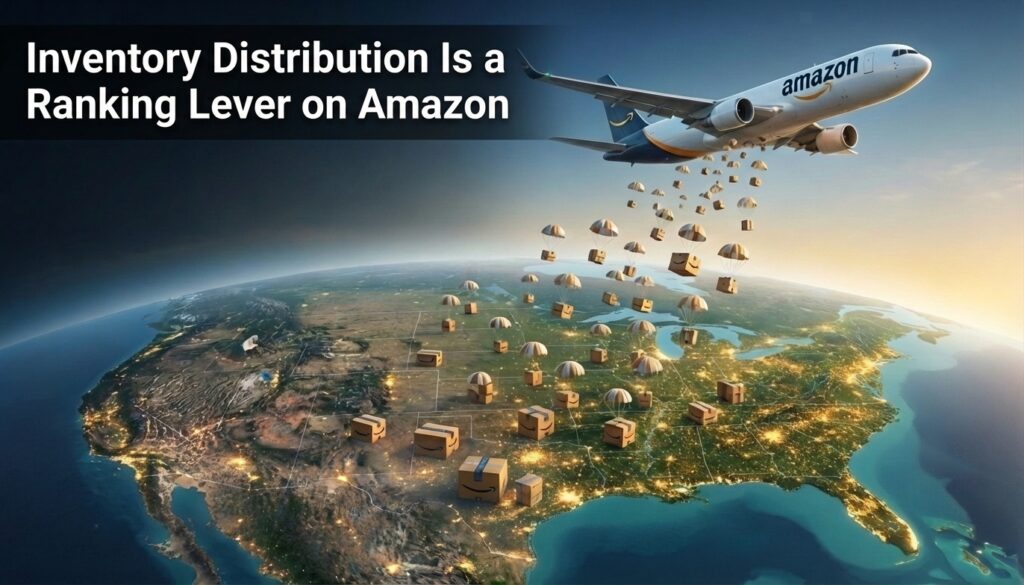
Inventory Distribution Is a Ranking Lever on Amazon
TL;DR
Amazon inventory distribution directly affects your search rank. Regions without nearby stock get slower delivery promises, lower conversion, and weaker organic visibility. Treat distribution like SEO, not just operations.
If you sell on Amazon, your inventory distribution can quietly decide how much you sell and how stable your keyword rank is. This guide breaks down why Amazon inventory distribution impacts delivery speed, conversion, and search visibility, plus the fastest ways to diagnose and fix coverage gaps.
Jump to the section you need:
The ranking problem you can't fix with keywords
If you've ever watched your keyword rank hold steady in one part of the country and slide in another, you're not imagining it. We've been seeing search ranks decline (aka get worse) in areas that don't have local inventory, even when everything else looks "right" (titles, images, price, reviews, PPC).
That pattern makes more sense when you look at how Amazon's customer experience actually works today: search is not just "what's relevant." It's "what's relevant and can get to this shopper fast." Amazon inventory distribution is baked into the ranking equation whether sellers realize it or not.
Why Amazon inventory distribution changes rank: two incentives that align
This is the core logic behind what we're seeing.
1) Faster delivery improves conversion (and Amazon protects conversion)
When your offer shows same-day or one-day delivery, customers buy more often. When it shows 3-6 days, conversion usually drops.
That matters because Amazon's ranking system is a merchandising engine. It wants to surface offers that shoppers are most likely to buy. Better delivery promises tend to drive better conversion, and better conversion tends to earn more organic visibility. Amazon has discussed this philosophy in their Fulfillment by Amazon overview, where they explicitly tie FBA to the Prime badge and Buy Box eligibility.
2) Non-local inventory increases Amazon's cost
From the seller side, your FBA fulfillment fee does not change if the customer is 1 mile away or 500 miles away. From Amazon's side, the cost to move that unit absolutely changes.
So if two listings are close in relevance and performance, the listing that can be fulfilled more efficiently (because inventory is closer to demand) often has a built-in advantage. It's better for the customer and cheaper for Amazon. A 2024 report from Amazon noted they've been aggressively regionalizing fulfillment to cut last-mile costs and speed up delivery, which only reinforces this dynamic.
How to diagnose this quickly (in under 10 minutes)
This is easy to check. Just change the "Deliver to" ZIP code on Amazon and repeat the same search in a few parts of the country.
This is not meant to be perfect proof. It is a fast way to spot whether regional delivery speed may be dragging down your visibility.
Pick your most important keyword and test three to five ZIP codes across different regions:
- One Northeast ZIP
- One Southeast ZIP
- One Midwest ZIP
- One Texas or central ZIP
- One West Coast ZIP
For each ZIP code:
- Open Amazon in an incognito or private window
- Set the delivery ZIP code
- Search your main keyword
- Find your listing and note your rank
- Note your delivery promise
- Check the top competing listings and note whether they show a faster delivery promise than you do
Here's what this looked like for one of our SKUs last month:
| Region | ZIP Code | Your Delivery Promise | Top Competitor Promise | Your Rank Position |
|---|---|---|---|---|
| Northeast (NJ) | 07030 | Tomorrow | Tomorrow | #6 |
| Southeast (GA) | 30301 | Tomorrow | Tomorrow | #8 |
| Midwest (IL) | 60601 | 2 days | Tomorrow | #14 |
| Central (TX) | 75201 | 3 days | Tomorrow | #22 |
| West Coast (OR) | 97201 | 4 days | Tomorrow | #41 |
The pattern is easier to interpret when you compare your delivery promise against the listings above you. If your delivery speed gets worse in certain regions while competitors still show faster arrival dates, that is a strong signal that fulfillment coverage is hurting you there.
This is a quick diagnostic, not final proof. But if you repeatedly see slower delivery promises and weaker rank in the same regions, you are likely looking at a distribution problem, not just a listing problem.
That is when it makes sense to stop checking ZIP codes and start fixing coverage: better replenishment timing, stronger regional inventory positioning, and PPC that matches where you can actually deliver fast.
What successful brands do differently: build "rank coverage," not just "days of supply"
Here's the mindset shift:
Stop managing only total inventory. Start managing regional availability.
Once you see Amazon inventory distribution as a ranking input, the playbook changes. These are the tactics that actually move the needle:
1) Set a national Prime-speed floor for hero SKUs
For top sellers, the goal is not "avoid stockout." The goal is "stay fast nationwide." That usually means higher minimums and earlier replenishment. If you don't already have a system for this, the reorder point formula is a good starting point for setting those minimums by SKU. Or skip the spreadsheet and use our free reorder point calculator for an instant trigger.
2) Treat lead time like a ranking variable
Long or unpredictable lead times force thin inventory, which often means inventory concentrates in fewer fulfillment centers and delivery promises get worse for far-away shoppers.
If you want the deeper playbook for tightening this up, use: Lead Time for Amazon Sellers: What It Is, Why It Matters, and How to Improve It.
3) Use upstream buffer inventory so you're not panic-shipping
The best operators don't "catch up" after they go thin. They keep a buffer (3PL, upstream storage, or a steady inbound cadence) so the network stays healthy. Your safety stock calculation should account for this: it's not just about covering demand spikes, it's about keeping enough units flowing to stay distributed. If you're sizing it from scratch, our free safety stock calculator takes the variability inputs and returns a buffer in seconds.
4) Plan seasonal spikes like a coverage event, not a sales event
Peak periods amplify regional depletion. If you want a calendar-driven approach to staying fast (and staying Prime-eligible), reference: Amazon Seller Q4 Survival Guide.
5) Align PPC with inventory reality
If you're under-covered in the West, blasting nationwide PPC can accelerate the problem (you sell out locally, delivery slows, conversion drops, rank follows). A better approach is to defend where you can win fast delivery, then expand as coverage improves.
Bottom line
Inventory is not just operations. On Amazon, it is a search lever.
When you treat Amazon inventory distribution like SEO, you get:
- Faster delivery promises
- Higher conversion
- Lower cost-to-serve for Amazon
- More stable rank across the country
If your rank is sliding only in some states, start with the inventory map before you rewrite your listing.
FAQ
Does Amazon rank products differently by region?
Yes. Amazon personalizes search results based on the shopper's location. If your inventory is far from a buyer's ZIP code, your delivery promise gets slower, which typically lowers your conversion rate in that region. Lower conversion signals to Amazon's algorithm that your listing is less relevant there, so your organic rank can drop in those geographies while staying strong in areas where you have local stock.
How does delivery speed affect Amazon search ranking?
Amazon's search engine prioritizes offers that are likely to convert. Faster delivery (same-day, one-day) consistently drives higher conversion than 3+ day estimates. Since conversion is one of the strongest ranking signals, listings with fast delivery tend to earn better organic positions. This is also why two identical listings can rank differently in different parts of the country: the one with nearby FBA inventory wins the delivery promise and gets the visibility boost.
How do I check if my FBA inventory is distributed evenly?
The quickest method is a ZIP code audit. Pick your most important keyword and search it from five different ZIP codes (Northeast, Southeast, Midwest, Central, West Coast). For each, note your delivery promise and rank position. If you see slower delivery and worse rank in the same regions, you have a distribution problem. The whole test takes under 10 minutes and gives you a clear picture of where your coverage gaps are.

15+ years in the Amazon selling world, helping hundreds of brands figure out inventory without losing their minds. I built Forecastly, which became the go-to tool for Amazon inventory forecasting before Jungle Scout acquired it. After leading Product and Design at Jungle Scout for several years, I missed being close to the real problems sellers face. In 2025, I kept hearing the same thing: inventory tools were too complex, too expensive, or just didn't fit. So I built Profit Hawk.