Incoterms for Amazon Sellers: A Practical Guide to FOB, DDP, and Risk Transfer
TL;DR
Incoterms are the international rules that decide who pays and who carries the risk at each step of a shipment. For most Amazon FBA sellers, FOB gives the best balance of cost and control, while DDP trades convenience for real customs liability. Pick your Incoterm before you negotiate price, not after.
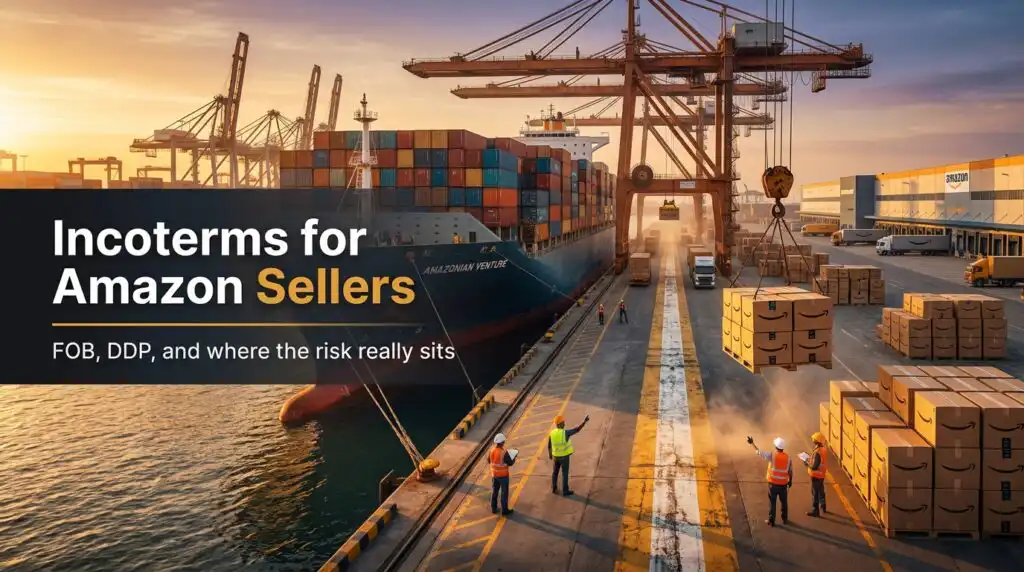
If you have ever stared at a supplier quote that said "FOB Shenzhen" and just nodded along, this guide is for you. Incoterms for Amazon sellers are not academic trivia. They decide who pays for freight, who eats the loss if a container goes overboard, and whose name sits on the customs entry when U.S. Customs comes asking questions.
So let us cut through the alphabet soup. Below, I break down the handful of Incoterms you actually see on supplier quotes, show you exactly where risk changes hands, and tell you which ones I recommend for a growing FBA business.
Jump to the section you need:
What Are Incoterms, and Why Do They Matter for Amazon Sellers?
Incoterms are a set of standardized trade rules published by the International Chamber of Commerce. In plain terms, they define the exact moment when responsibility for a shipment passes from your supplier to you. That covers who pays for each leg of transport, who arranges insurance, and who carries the risk if something goes wrong along the way.
Incoterm: a three-letter shorthand (like FOB or DDP) that sets who is responsible for the cost, the risk, and the paperwork at each stage of an international shipment. The current version is Incoterms 2020, published by the ICC.
For an Amazon seller, this matters more than it does for a casual importer. Your inventory has to clear customs, get prepped, and check in at an FBA warehouse before it earns a single dollar. Every handoff in that chain is governed by the Incoterm you agreed to. So when you pick the wrong one, you either overpay or you inherit risk you never priced in. That is why understanding Incoterms for Amazon sellers is really about protecting cash flow, not passing a trade-terms quiz.
Here is the part most sellers miss. The Incoterm is a negotiating lever, not a formality. Suppliers quote different prices for FOB versus DDP because they are bundling different services and different risk into that number. First understand what you are actually buying. Then negotiate the price around it.
The Incoterms Every FBA Seller Actually Sees
There are 11 Incoterms in the 2020 rules. Honestly, you only need to know a handful. These are the ones that show up on real supplier quotes from China and other manufacturing hubs.
The table below sums up who does what for the six terms you are most likely to meet. Read it as a quick reference, then keep going for the nuance that the table cannot capture.
| Term | Full name | Who arranges main freight | Who clears U.S. customs | Best for |
|---|---|---|---|---|
| EXW | Ex Works | You (from the factory door) | You | Rarely a good fit for FBA |
| FCA | Free Carrier | You (from a named point) | You | Air freight, experienced sellers |
| FOB | Free On Board | You (from the origin port) | You | Most FBA ocean shipments |
| CIF | Cost, Insurance and Freight | Supplier (to the destination port) | You | Sellers who want less origin hassle |
| DAP | Delivered at Place | Supplier (to your door) | You | Hands-off delivery, you still clear customs |
| DDP | Delivered Duty Paid | Supplier (to your door) | Supplier | Convenience, but read the warnings below |
Notice a pattern. As you move down the list, the supplier takes on more of the work, and the price of the goods goes up to match. EXW puts nearly everything on you. DDP puts nearly everything on the supplier. FOB sits in the sweet spot for most sellers, and I will explain why in a moment.
Confused by freight terms? Get the plain-English version monthly.
We break down Amazon FBA logistics and inventory topics with real examples and no jargon. Subscribe and never miss a breakdown.
Where Does Risk Actually Transfer?
The risk transfer point is the spot where a loss stops being your supplier's problem and becomes yours. This is the single most important thing an Incoterm tells you, and it is where sellers get burned.
Under FOB, risk passes once the goods are loaded on board the vessel at the origin port. So if the container is damaged in transit across the Pacific, that loss is on you, not the factory. That is why marine cargo insurance matters even on an FOB deal.
CIF looks safer because the supplier pays for freight and insurance to the destination port. But watch the fine print. Under CIF, the cost divide and the risk divide are not the same point. The supplier pays freight to the destination, yet risk still transfers to you back at the origin port, the moment the goods are loaded. In other words, you are buying the insurance, but you carry the risk from day one.
DAP and DDP are the friendliest on paper. Risk stays with the supplier all the way to your named destination, whether that is your prep center or a specific address. The difference between them is customs. Under DAP, you clear customs and pay the import duties. Under DDP, the supplier handles customs and duties too. Either way, remember that for FBA inventory you remain the party U.S. Customs and Border Protection holds accountable as the importer of record.
Which Incoterms for Amazon Sellers Make the Most Sense?
For most Amazon FBA sellers, FOB is the right default. It hands you control of the expensive part of the journey, the international freight and the customs entry, while keeping the supplier responsible for getting the goods safely onto the ship. You also get to shop your own freight forwarder instead of accepting whatever margin the factory bakes into a door-to-door quote.
Early on, when you are placing your very first order with a new supplier, CIF or even DDP can be a reasonable training-wheels choice. You trade some money for simplicity while you learn the ropes. That is fine for one or two orders. Past that, the bundled convenience gets expensive fast.
Here is a concrete example. Say you import a 40-foot container of goods worth 30,000 dollars. A DDP quote might look clean and simple at one flat number. But when I have compared that against sourcing FOB and hiring an independent forwarder, sellers routinely save 8 to 15 percent on the total landed cost, and they get real tracking instead of a black box between the factory and the door.
There is a second reason FOB wins for serious sellers: visibility. Your Incoterm quietly sets your true lead time, and lead time drives how much inventory you need to hold. When you control the freight, you can see delays coming and feed accurate transit times into your reorder point math. When the factory controls everything under DDP, you are guessing.
Common Incoterms Mistakes FBA Sellers Make
Most Incoterms pain is self-inflicted. These are the mistakes I see over and over, and each one is avoidable.
- Treating DDP as a free lunch. The convenience is real, but so is the liability. You are still the party Amazon expects to own the import, and you can be held responsible for a bad declaration you never saw.
- Skipping cargo insurance on FOB and CIF shipments. Risk sits with you from the origin port. So one damaged container without coverage can wipe out the margin on the whole order.
- Ignoring the FBA leg entirely. No Incoterm covers the final step from your door to a sellable listing. Your goods still need prep and an FBA check-in, and that time counts against your inventory turnover.
- Confusing the cost point with the risk point. As we saw with CIF, they split. Read every quote for both, not just the price.
- Never naming the exact destination. "DAP" means little without a named place. Spell out the precise address so there is no argument about where the supplier's job ends.
Fix these five and you have solved the vast majority of freight disputes before they start.
Here is the bottom line. Get Incoterms for Amazon sellers right, and you turn one of the most confusing parts of importing into a real advantage. You will price landed cost accurately, protect yourself from customs surprises, and feed cleaner transit times into your inventory planning. That is worth far more than the few minutes it takes to read the term on your next quote.
Incoterms FAQ for Amazon Sellers
What is the best Incoterm for Amazon FBA?
FOB is the best Incoterm for most Amazon FBA sellers. It keeps the supplier responsible until the goods are loaded at the origin port, then hands you control of freight and customs. That control lets you shop forwarders, track shipments, and manage your true lead time.
Is DDP shipping safe for Amazon FBA?
DDP can be safe, but only when the declared value and HTS codes are accurate and the arrangement is legitimate. The risk is that a supplier's broker under-declares value to lower duties. You can still be liable for back-duties and penalties, so vet any DDP deal carefully.
What is the difference between FOB and DDP?
FOB means the supplier delivers the goods onto the vessel, and you handle freight, insurance, customs, and duties from there. DDP means the supplier handles everything to your door, including U.S. customs and duties. FOB gives you more control, while DDP gives you more convenience at a higher price.
Does Amazon act as the importer of record?
No. Amazon will not act as the importer of record for your FBA inventory. You, or a designated importer acting on your behalf, must file the customs entry, pay the duties, and take legal responsibility for the import.

15+ years in the Amazon selling world, helping hundreds of brands figure out inventory without losing their minds. I built Forecastly, which became the go-to tool for Amazon inventory forecasting before Jungle Scout acquired it. After leading Product and Design at Jungle Scout for several years, I missed being close to the real problems sellers face. In 2025, I kept hearing the same thing: inventory tools were too complex, too expensive, or just didn't fit. So I built Profit Hawk.