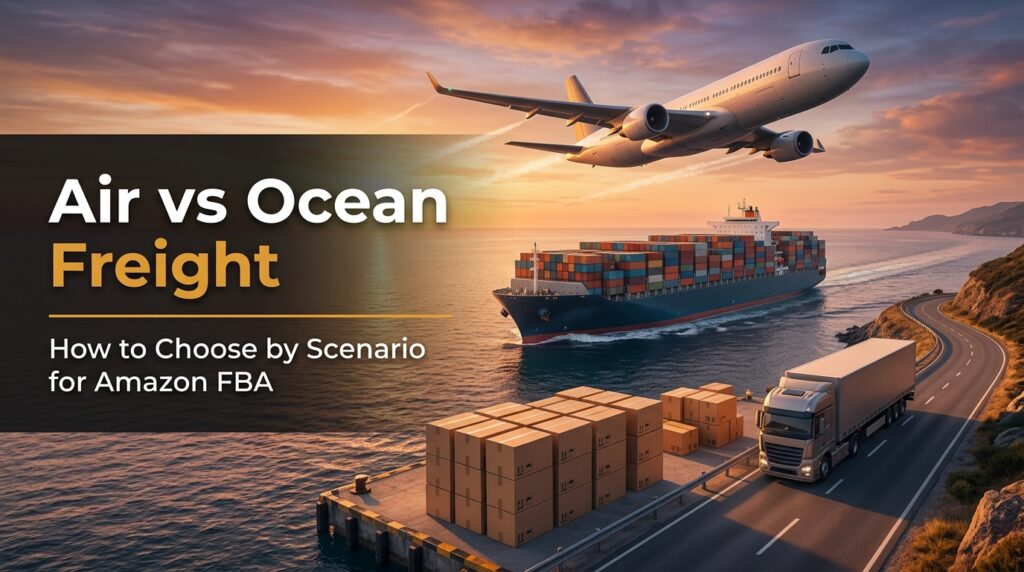
Air vs Ocean Freight for Amazon FBA: How to Choose by Scenario
TL;DR
Air freight moves Amazon FBA inventory in about 5 to 12 days but costs $4.50 to $8 per kilogram. Ocean freight takes 30 to 45 days at roughly $0.30 to $0.80 per kilogram. Choose air for launches and thin buffers, ocean for planned restocks, and ground for the domestic leg.
Choosing between air vs ocean freight is one of the most expensive recurring decisions you make as an Amazon seller. Get it right and you protect both your cash and your Buy Box. Get it wrong and you either bleed margin on air you never needed, or you stock out waiting on a boat. Ground freight sits quietly in the middle, moving your goods the last leg once they land. So the real question is not which mode is best overall. It is which mode fits this shipment, this SKU, and this moment.
Jump to the section you need:
Air vs Ocean Freight: The Core Tradeoff
Air vs ocean freight comes down to one tradeoff: speed against cost. Air is fast and expensive. Ocean is slow and cheap. Almost everything else is a detail layered on top of those two facts.
Freight mode is how your inventory travels from your supplier to Amazon. Air freight uses cargo planes and lands in days. Ocean freight uses container ships and lands in weeks. Ground freight (LTL or full truckload) moves goods overland, usually on the domestic leg after import.
Here are the numbers most sellers care about. Air freight from China usually reaches an Amazon fulfillment center in 5 to 12 days. Ocean freight takes 25 to 45 days on the water, and the full timeline from purchase order to a live listing often runs 6 to 8 weeks. By contrast, air compresses that same door-to-shelf timeline to about 2 to 3 weeks.
The cost gap is just as wide. In 2026, air freight from China to the US runs roughly $4.50 to $8 per kilogram, and peak season can push that 25 to 40 percent higher. Ocean lives in another world. Full container load rates work out to about $0.20 to $0.50 per effective kilogram, while less than container load sits around $0.30 to $0.80. In plain terms, air costs 6 to 15 times more per kilogram than ocean.
| Mode | Transit to FC | Cost per kg (China to US) | Best for |
|---|---|---|---|
| Air (standard or express) | 5 to 12 days | $4.50 to $8.00 | Launches, emergency restocks, high-margin SKUs |
| Ocean LCL | 25 to 40 days | $0.30 to $0.80 | Small to mid restocks, mixed SKUs |
| Ocean FCL | 25 to 45 days | $0.20 to $0.50 | Large planned restocks, dense products |
| Ground (LTL or FTL) | 2 to 7 days (domestic) | Varies by lane | Port or 3PL to FBA, the last leg |
Why Your Freight Choice Is a Cash Flow Decision
Freight mode is really a cash flow decision wearing a logistics costume. When you book ocean, you are not just accepting a longer wait. You are parking cash on the water for 6 to 8 weeks before a single unit can sell. That money is gone from your account, unavailable for ads, new products, or your next purchase order.
Air flips the equation. You pay far more per kilogram, but your capital comes back faster because inventory sells sooner. For a fast mover with healthy margins, that quicker turn can easily be worth the premium. For a slow, heavy, low-margin product, it rarely is.
Then there is a second cost that never appears on a freight invoice: the stockout. When you run dry, you lose sales velocity, you can lose the Buy Box, and your organic rank slips. Recovering that rank often costs more in ad spend than the air freight would have. This is exactly why your reorder point and lead time should drive the freight decision as much as the price sheet does.
Freight speed also feeds your inventory turnover. Slower ocean legs mean more cash tied up per turn, so your working capital has to stretch further.
How to Run the Break-Even Math on Air vs Ocean Freight
Most sellers compare air and ocean on the sticker price per kilogram. That is the wrong unit. Carriers do not bill you on actual weight alone. Instead, they bill on chargeable weight, whichever is greater between actual weight and volumetric weight.
Volumetric weight punishes light, bulky boxes. The air freight formula divides your box volume in centimeters by 6000. So a carton measuring 80 by 60 by 50 cm holds 240,000 cubic centimeters. Divide by 6000 and you get 40 kg of volumetric weight. If that box actually weighs 25 kg, you still pay for 40. (Courier services often use a 5000 divisor, which stings even more.)
Once you know chargeable weight, the break-even is straightforward. Follow these steps:
- Calculate chargeable weight for the full shipment. Compare actual weight against volumetric weight (length x width x height / 6000) and take the larger number.
- Quote both modes for that chargeable weight. Get an air rate and an ocean rate for the same cargo.
- Add the hidden costs. Include customs duties, drayage, deconsolidation, and per-unit prep so you compare landed cost, not just freight.
- Divide the freight difference by your unit count. This gives you the true air premium per unit.
- Weigh that premium against margin and stockout risk. If air adds $0.60 per unit on a product that nets $9, and you are close to empty, air is cheap insurance.
Here is a quick example. Say you have a 500 kg dense shipment. Ocean might land it for $400 to $800. Air for the same cargo could run $2,500 to $4,000. If that shipment holds 2,000 units, the air premium works out to roughly $1 to $1.60 per unit. Whether that is worth paying depends entirely on your margin and how close you are to zero.
For heavy or bulky goods, air rarely pencils out. The industry break-even for dense cargo on the China to US lane sits around 150 to 300 kg. Above that, ocean wins on pure cost almost every time.
Where Ground Freight Fits
Ground freight is the leg most sellers forget to price until the invoice lands. It moves your goods overland, and for Amazon sellers that usually means the domestic hop: port to a 3PL, 3PL to Amazon, or your warehouse to a fulfillment center. The two common flavors are LTL (less than truckload) and FTL (full truckload), plus small parcel for lighter shipments.
Ground almost never competes with air or ocean on the international leg. Instead, it stacks on top. Your ocean container clears customs at the port, then a truck carries it inland. That drayage and LTL cost belongs in the landed cost math from the last section.
Ground also got more strategic once Amazon's inbound placement fees arrived. When you send one big shipment to a single center, Amazon may charge a placement fee to spread it across the network. Splitting inbound across multiple centers, often by LTL, can lower or remove that fee. A freight forwarder like Flexport can coordinate the ocean and ground legs together so nothing sits idle at the port.
Want breakdowns like this in your inbox?
We turn messy Amazon logistics into plain math and clear rules. Subscribe for monthly FBA inventory insights, no fluff.
Choosing Freight by Scenario
Enough theory. The right freight mode depends on the moment, not a fixed rule. Below is the cheat sheet I actually use. Match your shipment to the closest row.
| Scenario | Best mode | Why |
|---|---|---|
| New product launch, unproven demand | Air, small batch | Test demand fast without parking cash for two months |
| Planned restock, stable demand | Ocean FCL or LCL | You have lead time, so pay the cheap rate |
| Near stockout on a top seller | Air express | Protect rank and Buy Box; the premium beats lost sales |
| High-margin, small, light SKU | Air often works | Low chargeable weight keeps the air premium tiny |
| Low-margin, heavy, bulky SKU | Ocean | The air premium eats the whole margin |
| Q4 seasonal push, known dates | Ocean early, air backup | Cheap base stock plus a fast safety valve |
| Port or 3PL to Amazon | Ground (LTL or SPD) | Short domestic leg; split inbound to trim placement fees |
The Hybrid Play: Split Air and Ocean
You do not have to pick one mode for the whole order. The smartest sellers I know run a two-speed shipment, and it is my favorite move for launches and volatile SKUs.
The play is simple. Send a small batch by air so you can start selling in two to three weeks. At the same time, put the bulk of the order on the water. By the time your air stock winds down, the ocean container arrives to refill the shelf. As a result, you get both speed and cost efficiency from a single purchase order.
This works for steady restocks too. Ship your base stock by sea for the low rate, then use small air top-ups to cover forecast misses and demand spikes. It is a buffer against being wrong, which, if we are honest, is most of the time.
The catch is coordination. You have to know each SKU coverage, sell-through, and lead time to size the air and ocean portions correctly. Do it by gut and you either over-air and waste money, or under-air and stock out anyway.
Common Freight Mistakes Sellers Make
A few freight mistakes show up again and again. These are the ones that cost the most.
Defaulting to one mode for everything. Ocean-only sellers stock out. Air-only sellers give away margin. Match the mode to the shipment instead.
Quoting on actual weight and ignoring chargeable weight. That light, bulky carton can double your air bill overnight.
Forgetting Amazon receive time. Your goods can sit at the fulfillment center for days before they go live. Build that lag into your lead time, or your reorder point will be short.
Booking Q4 ocean too late. Miss the cutoff and you get forced onto peak-season air at panic prices.
Ignoring inbound placement fees. One giant shipment to a single center can trigger a fee that a split LTL shipment would have avoided.
Bottom line: air vs ocean freight is not a loyalty test. It is a per-shipment calculation. Weigh speed against cost, run the chargeable-weight math, and split the order when the moment calls for it. Do that consistently and freight stops being a guessing game.
Air vs Ocean Freight FAQ
When should I use air freight instead of ocean for Amazon FBA?
Use air freight when speed protects revenue: product launches, emergency restocks near a stockout, or high-margin, low-weight SKUs. Air lands in 5 to 12 days versus 25 to 45 for ocean. The faster cash turn and protected rank usually justify the higher rate in those cases.
How do I calculate the break-even point between air and ocean freight?
Calculate chargeable weight first (the greater of actual weight or length x width x height / 6000), then quote both modes for that weight. Add customs, drayage, and prep, divide the freight difference by your unit count, and compare that per-unit premium to your margin. For dense cargo, ocean usually wins above 150 to 300 kg.
Is ground freight cheaper than air for Amazon FBA restocks?
Ground freight is not a substitute for air or ocean on the international leg. It handles the domestic hop from port or 3PL to Amazon. Per mile, ground (LTL or FTL) is far cheaper than air, and splitting inbound across centers can also reduce Amazon placement fees.
Should I split my shipment between air and ocean?
Yes, splitting is often the smartest option, especially for launches and volatile SKUs. Send a small air batch to start selling in two to three weeks, and put the bulk on the water for the low rate. The ocean container then refills the shelf as your air stock runs down.

15+ years in the Amazon selling world, helping hundreds of brands figure out inventory without losing their minds. I built Forecastly, which became the go-to tool for Amazon inventory forecasting before Jungle Scout acquired it. After leading Product and Design at Jungle Scout for several years, I missed being close to the real problems sellers face. In 2025, I kept hearing the same thing: inventory tools were too complex, too expensive, or just didn't fit. So I built Profit Hawk.