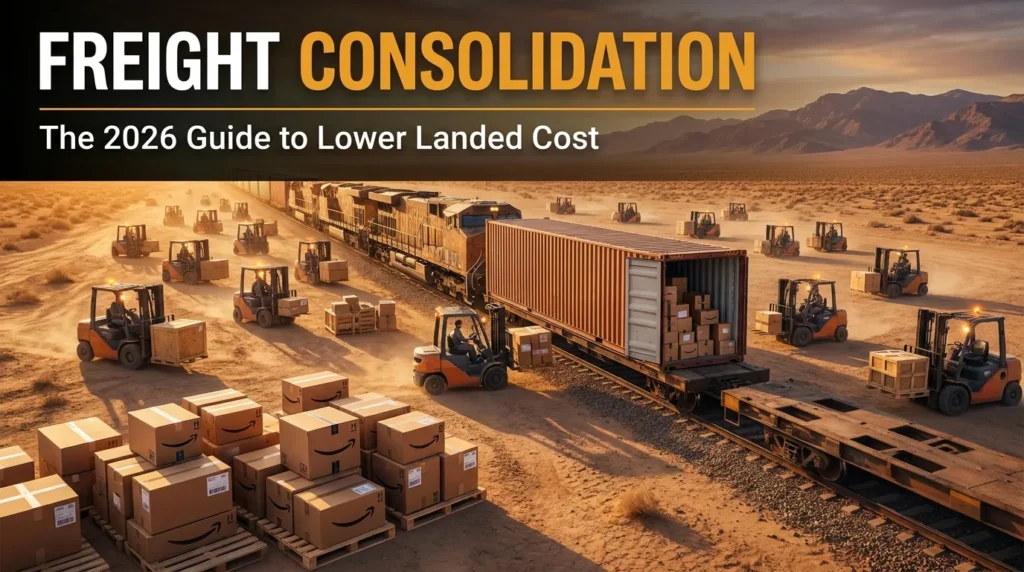
Freight Consolidation for Amazon FBA: The 2026 Guide to Lower Landed Cost
TL;DR
Freight consolidation means combining separate shipments into one larger, palletized, container-scale move to Amazon. For most FBA sellers past 12 to 15 CBM per order, freight consolidation cuts per-unit freight by 30 to 50 percent and lowers total landed cost enough to add real margin points.
Most sellers I talk to obsess over their unit cost from the factory and barely glance at the freight line. That is backwards. Freight consolidation is one of the few levers that lowers your landed cost without touching product quality, and it usually pays off faster than renegotiating with your supplier.
In this guide I will walk through when to consolidate, how the math actually works, and the Amazon pallet rules that trip people up. None of it is complicated. It just takes a little discipline at order time.
Jump to the section you need:
What Is Freight Consolidation for Amazon FBA?
Freight consolidation is the practice of merging multiple smaller shipments into one larger shipment before it reaches Amazon, so fixed shipping fees and container space get shared across more units.
Instead of three suppliers each sending a separate LCL (less-than-container-load) ocean shipment, your forwarder pools them at an origin warehouse and ships one container. The same idea works at the destination, where a prep center consolidates your cartons onto pallets and sends full truckloads into the fulfillment network.
The reason it matters is simple. Freight pricing rewards volume and punishes fragmentation. Every separate shipment carries its own fixed costs: a customs entry, a brokerage fee, destination handling, and a delivery appointment. So when you consolidate, you spread those fixed costs across more units, and your per-unit landed cost drops even when the ocean rate per cubic meter stays flat.
There are two main flavors. First, origin consolidation combines goods from different factories into one container in the source country. Second, destination consolidation combines your inbound cartons into palletized freight once they land. Many sellers use both, and the savings stack.
How Freight Consolidation Lowers Your Landed Cost
Landed cost is the all-in cost to move one unit from the factory floor to an Amazon shelf. It covers product cost, freight, insurance, duties, brokerage, prep, and inbound placement. Sellers routinely underestimate this number by 15 to 40 percent, which means they think they are more profitable than they really are. You can pressure-test your own numbers with our inventory turnover and GMROI calculator, which measures inventory at true landed cost.
Here is where freight consolidation does its work. First, it slashes the per-CBM ocean rate. When you fill a container instead of booking LCL space, the per-cubic-meter cost typically drops 30 to 50 percent. Next, it collapses duplicate fixed fees: one customs entry instead of three, one brokerage charge instead of three. Finally, it can help you skip Amazon's inbound placement fee when a prep center splits inventory across fulfillment centers for you.
Let me show you the math with an example. Say you sell two SKUs from two different factories in the same province, and together they add up to 18 CBM and 4,000 units for this order.
| Cost line | Two separate LCL shipments | One consolidated container |
|---|---|---|
| Ocean freight | 18 CBM x $220 = $3,960 | 20ft container flat = $2,400 |
| Customs entries and brokerage | 2 x $250 = $500 | 1 x $250 = $250 |
| Origin consolidation fee | none | $300 |
| Total inbound cost | $4,460 | $2,950 |
| Per-unit inbound cost | $1.12 | $0.74 |
That is a swing of $0.38 per unit, roughly a 34 percent cut on the inbound portion of landed cost. On 4,000 units, you just saved about $1,510 on one order. Run that across a year of replenishment and the number gets serious. Your exact rates will differ, but the shape of the savings holds whenever you ship enough to fill a container. For the analytics side, tools like Flexport track per-unit landed cost across freight and duties.
Want landed-cost breakdowns like this in your inbox?
We publish monthly Amazon FBA guides with real math and worked examples. Subscribe and get every new breakdown as it drops.
When Should You Consolidate Your Shipments?
Consolidation is not free, so it does not always win. The crossover that matters most is the LCL-to-FCL breakeven, which usually sits around 12 to 15 CBM per shipment. Below that, LCL is often cheaper per unit because you only pay for the space you use. Above it, filling a container almost always wins.
Here is the decision I run through before every large order:
- Add up total CBM across all suppliers for this replenishment window. If it clears 15 CBM, price out a full container.
- Check whether multiple suppliers sit in the same region. If they do, origin consolidation is on the table.
- Compare the all-in per-unit cost, not the headline freight rate. Include every fixed fee.
- Factor in speed. Consolidated moves often check in faster than fragmented LCL, which can drag on for weeks.
- Weigh your cash conversion cycle. A bigger single order ties up more cash upfront, even when the per-unit cost is lower.
That last point is the one sellers forget. Lower landed cost is great, but not if it strands your working capital. This is the same tension you manage with your reorder point and safety stock: buy enough to earn the freight break, but not so much that you choke cash flow or blow past your storage limits. If your lead time is already long, the bigger order also sits in transit longer, so plan the timing carefully.
Amazon's Pallet Rules and the SPD-vs-LTL Decision
Once your freight lands, you face a second consolidation choice: how to send it into Amazon. Small parcel delivery (SPD) moves individual cartons through a parcel carrier. Less-than-truckload (LTL) moves palletized freight on a truck. As a rule of thumb, switch to LTL once your shipment fills a pallet or more, because palletized freight lowers per-unit cost and checks in faster than Amazon scanning dozens of loose cartons.
If you go the pallet route, Amazon's FBA requirements are strict and worth memorizing. Non-compliant pallets get hit with unplanned-services fees, or worse, refused at the dock.
| Requirement | Amazon FBA pallet spec |
|---|---|
| Pallet type | GMA standard 48 x 40 inch |
| Entry | 4-way entry |
| Condition | Grade A, no broken boards |
| Max weight | 1,500 lb per pallet |
| Max height | 72 inches including the pallet deck |
Get these wrong and the savings you earned on ocean freight can vanish in penalty fees. That is why many sellers hand the destination leg to a prep center that palletizes to spec and consolidates loads into full trucks bound for regional fulfillment centers.
Common Freight Consolidation Mistakes That Erase the Savings
I have watched sellers do the freight math right and still lose the savings on the back end. A few traps show up again and again.
First, consolidating suppliers who cannot align their production timelines. If factory A is ready three weeks before factory B, holding A's goods at a warehouse racks up storage that eats your freight savings. So consolidation only works when your suppliers ship within a tight window of each other.
Second, ignoring the cash conversion cycle. A full container is a bigger check written earlier. If that timing strains your cash, the cheaper per-unit cost is a false economy.
Third, treating landed cost as a one-time calculation. Freight rates, fuel surcharges, duties, and placement fees all move. If you priced consolidation once in 2024 and never revisited it, your assumptions are probably stale. Recompute landed cost per SKU whenever your freight forwarder, duty rate, or order size changes.
Fourth, picking a forwarder who does not know Amazon. A partner fluent in FBA appointments and prep rules keeps your paperwork clean and your delivery windows booked. Programs like Amazon Global Logistics can also consolidate LCL freight and route it straight to fulfillment centers, which is worth pricing against a third-party forwarder.
Your Freight Consolidation Quick Checklist
Before you book your next replenishment, run this fast:
- Total CBM across suppliers clears 12 to 15? Price a full container.
- Suppliers in the same region and ready in the same window? Consolidate at origin.
- Shipment fills a pallet or more into Amazon? Move to LTL and palletize to spec.
- Recomputed landed cost per unit, including every fixed fee? Only then compare.
- Cash conversion cycle still healthy at the bigger order size? Green light.
Bottom line: freight consolidation is one of the cleanest ways to lower your landed cost without renegotiating a single supplier contract. Run the CBM math, respect the pallet rules, and revisit your numbers each time your volume or rates shift. Do that consistently and freight consolidation turns the shipping line from an afterthought into a real margin lever.
Frequently Asked Questions
How does freight consolidation lower landed cost for Amazon FBA?
Freight consolidation lowers landed cost by spreading fixed shipping fees across more units and earning volume discounts on ocean freight. One customs entry, one brokerage charge, and a full-container rate replace the duplicated fees and higher per-CBM rates of multiple small shipments. For volumes above the LCL-to-FCL crossover, this typically cuts per-unit freight by 30 to 50 percent.
When should I switch from LCL to FCL for FBA?
Switch from LCL to FCL when your shipment consistently exceeds about 12 to 15 CBM. Below that threshold, LCL is usually cheaper because you only pay for the space you use. Above it, filling a container lowers your per-cubic-meter cost and speeds up handling.
Do Amazon FBA shipments need to be palletized?
Amazon FBA shipments need to be palletized when you ship LTL or FTL freight, but not for small-parcel deliveries. Palletized shipments must use 48 x 40 inch GMA pallets, be 4-way entry and Grade A, stay under 1,500 lb, and not exceed 72 inches in height including the pallet.
Can I consolidate goods from different suppliers into one shipment?
Yes. Origin consolidation combines output from multiple factories into a single container before it ships, which is one of the biggest landed-cost wins available to multi-supplier sellers. It works best when your suppliers are in the same region and can finish production within a similar time window.

15+ years in the Amazon selling world, helping hundreds of brands figure out inventory without losing their minds. I built Forecastly, which became the go-to tool for Amazon inventory forecasting before Jungle Scout acquired it. After leading Product and Design at Jungle Scout for several years, I missed being close to the real problems sellers face. In 2025, I kept hearing the same thing: inventory tools were too complex, too expensive, or just didn't fit. So I built Profit Hawk.