How to Build a Dual Sourcing Strategy for Amazon FBA
TL;DR
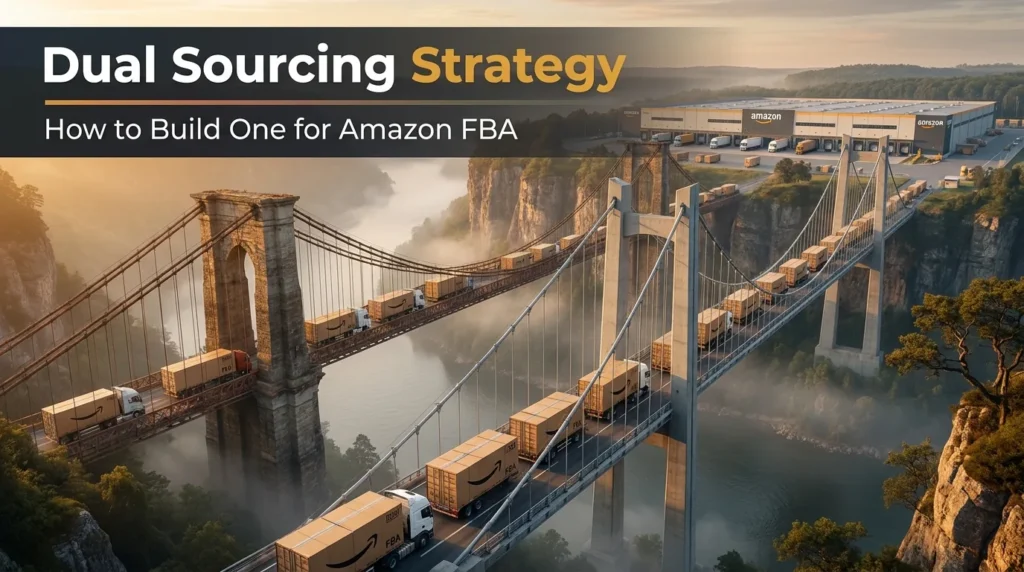
A dual sourcing strategy means buying the same product from two qualified suppliers instead of one. For Amazon FBA sellers, it prevents the stockouts that wreck your rank when a single factory misses a run. Split your volume, qualify a real backup, and write the terms down before you need them.
Picture this. Your best selling ASIN is humming along, and then your supplier emails you three days before a scheduled production run. The factory is closed for two weeks. You have 18 days of inventory left and a 45 day replenishment cycle. That gap is exactly what a dual sourcing strategy is built to close. I have watched sellers lose their Buy Box, their rank, and a quarter of their revenue over a single missed shipment. So let me walk you through how to set this up the right way.
Jump to the section you need:
What Is a Dual Sourcing Strategy for Amazon FBA?
A dual sourcing strategy is the practice of buying one product from two qualified suppliers instead of relying on a single factory. In plain terms, you build a backup before you need it.
Dual sourcing splits the purchase of a single SKU across two approved suppliers, usually on an uneven ratio like 70/30 or 80/20. The goal is supply continuity: if one supplier fails, the other keeps your Amazon inventory flowing.
The concept is not new. Manufacturers have done this for decades. In fact, research from McKinsey found that 39 percent of companies now pursue dual sourcing for critical components, and 73 percent reported progress on those initiatives in a recent survey. Amazon's own supply chain team also recommends the approach to reduce single supplier risk. What is new is how much it matters for Amazon sellers specifically. On Amazon, a stockout is not just a lost sale. It resets your momentum.
Here is the honest truth. Most private label sellers start with one supplier because it is simple and cheap. That works right up until it does not. Then a single delay cascades into lost rank, a suppressed Buy Box, and weeks of clawing back position.
Why Dual Sourcing Matters More for Amazon Sellers
For most businesses, a supply gap means a delayed order. On Amazon, it means algorithmic punishment. That is the difference, and it is why a dual sourcing strategy pays off faster for FBA sellers than almost anyone else.
Think about what a stockout actually costs you. First, you lose the sales during the gap. Next, your organic rank slides because the flywheel rewards velocity, and you have none. Then, when you finally restock, you are competing against your former self at a lower position. Recovering that rank can take three to six weeks of paid traffic and thin margins.
There is also your Inventory Performance Index to consider. Running dry hurts your IPI score, and a low score caps your FBA storage limits. So a supplier failure can quietly shrink your ability to stock your other winners too.
Cash flow is the quieter benefit. When you have two suppliers competing for your volume, you keep the upper hand on price. One vendor cannot corner you on a price hike when a second qualified source is one purchase order away. Some manufacturers report savings of up to 23 percent versus single sourcing, mostly from that competitive tension. That saving alone can fund the small premium you pay to keep a backup warm.
The math is simple. Say a two week outage on a product doing 10,000 dollars a month costs you 5,000 dollars in lost sales plus another 4,000 dollars in ad spend to recover rank. That is 9,000 dollars gone. A slightly higher unit cost on a 30 percent backup allocation looks cheap next to that.
How to Qualify a Backup Supplier
Do not skip this step. A backup you have never tested is not a backup. It is a phone number. Qualifying a second supplier is the part most sellers get wrong, because they wait until the emergency to start looking.
Here is the process I use:
- Source three candidates, not one. Use your existing sourcing channels, a sourcing agent, or trade shows. You want options so you can compare quality and terms.
- Order a paid sample run. Not a single unit. Order a small production batch, 50 to 200 units, and pay full freight. You are testing their real process, not their showroom.
- Inspect against your spec sheet. Compare the backup units to your primary supplier's output side by side. Check dimensions, materials, packaging, and defect rate.
- Run a small live pilot. Send that batch into FBA under the same ASIN and watch return rates and reviews for a few weeks. Real customers are the final quality check.
- Score and document. Rate the supplier on on time delivery, defect rate, communication speed, and price. Keep the scorecard so future you knows exactly where this vendor stands.
The table below shows a simple qualification scorecard you can copy.
| Criteria | Weight | What good looks like |
|---|---|---|
| Quality match | 30% | Defect rate within 1% of primary |
| Lead time | 25% | Quoted lead time plus a proven track record |
| Communication | 20% | Replies within 24 hours, flags problems early |
| Price | 15% | Within 10 to 15% of primary unit cost |
| Capacity | 10% | Can absorb your full volume in a pinch |
How to Split Volume in Your Dual Sourcing Strategy
Once your backup is qualified, you have to decide how much to buy from each. This is where a dual sourcing strategy becomes real. The split you choose depends on how risky the product is and how much margin you can spend on insurance.
An even 50/50 split is rare for FBA. It doubles your management overhead and gives up volume discounts on both sides. Most sellers do better with an uneven ratio that keeps a primary supplier happy while keeping a backup warm.
| Approach | Split | Best for |
|---|---|---|
| Warm backup | 90/10 | Stable products, tight margins, low disruption history |
| Balanced | 70/30 | Most private label winners with real revenue at stake |
| Aggressive | 50/50 | High risk products, single geography exposure, past failures |
The 70/30 split is my default for a product that matters. It sends enough volume to the backup that they treat you as a real customer, not a tire kicker. Meanwhile, your primary keeps the majority and the better pricing that comes with it.
One nuance. If your two suppliers sit in the same city or the same country, you have geographic concentration, not real redundancy. A port closure or a regional policy shift takes down both. For products exposed to tariff swings, a backup in a different country is worth the higher unit cost.
Want supply chain playbooks like this every month?
We break down FBA inventory and sourcing with real math and real scenarios. Subscribe and never miss one.
How to Structure a Dual Sourcing Contract
A handshake is not a strategy. The whole point of qualifying a backup is that they can ramp fast when you need them, and that only happens if the terms are agreed in advance. So put it in writing.
Your agreement with each supplier should spell out a few things clearly. Cover the unified quality spec, so both factories build to the same standard. Cover lead times and what happens when they slip. Cover a surge clause: how fast the backup can scale up, and at what price, if the primary goes down.
For the backup specifically, a minimum order guarantee keeps them engaged. If you promise a floor of volume each quarter, they hold capacity for you. Without it, your emergency order goes to the back of their queue behind their bigger accounts.
Also agree on communication cadence. A short quarterly review with each supplier, scored on delivery, quality, and responsiveness, keeps both honest. It also gives you early warning when a supplier's performance starts to drift.
Common Dual Sourcing Mistakes
Even sellers who set this up well trip over the same few things. Here are the ones I see most.
The first is treating the backup as an afterthought. If you never send them volume, they never prioritize you, and your surge order arrives late anyway. A warm backup needs at least a trickle of real orders.
The second is ignoring total landed cost. Sellers compare unit prices and forget freight, duties, and tariffs. A cheaper unit from a supplier with slower, pricier shipping can cost more delivered.
The third is over sourcing low risk products. You do not need two suppliers for a generic, easily replaced commodity with a dozen alternatives. Save the effort for your business critical winners. Spreading yourself thin across every SKU just multiplies overhead.
The last one is forgetting to plan the buffer. Dual sourcing reduces disruption risk, but it does not replace safety stock. You still need enough of a cushion to bridge the time it takes your backup to ramp, so your reorder point should build in that window. A backup that needs 30 days to produce and ship does you no good if you only carry 15 days of stock. So size your buffer around your backup's real ramp time, not your primary's normal lead time.
Frequently Asked Questions
What is a dual sourcing strategy?
A dual sourcing strategy is buying the same product from two qualified suppliers instead of one. It gives you a tested backup so a single factory delay does not turn into an Amazon stockout. Most sellers run it on an uneven split like 70/30 to keep costs down while keeping the backup warm.
When should an Amazon seller use dual sourcing?
Use it for your business critical products, the ASINs where a stockout would cost you real revenue and rank. Skip it for low margin commodities with lots of interchangeable suppliers. The higher unit cost only pays off when disruption would genuinely hurt.
How do you split volume between two suppliers?
Start with a 70/30 split for products that matter. That sends enough volume to the backup that they treat you as a real account, while your primary keeps the majority and the better pricing. Move toward 50/50 only when the product is high risk or your suppliers share a single geography.
Does dual sourcing replace safety stock?
No. Dual sourcing lowers the odds of a total supply failure, but a backup still needs time to ramp. You need safety stock to cover that ramp window, which is why your reorder point formula should account for it. Think of them as two layers of the same insurance policy, not substitutes.
The Bottom Line
A dual sourcing strategy is not about hedging every product you sell. It is about protecting the handful of winners that carry your business. Qualify a real backup, split your volume in a way that keeps them warm, and write the terms down before the emergency hits. Do that, and the next time a supplier goes dark, it is an inconvenience instead of a crisis.
If you want the day to day signals that tell you when a backup needs to step in, Profit Hawk tracks lead time and days of cover for every SKU automatically.

15+ years in the Amazon selling world, helping hundreds of brands figure out inventory without losing their minds. I built Forecastly, which became the go-to tool for Amazon inventory forecasting before Jungle Scout acquired it. After leading Product and Design at Jungle Scout for several years, I missed being close to the real problems sellers face. In 2025, I kept hearing the same thing: inventory tools were too complex, too expensive, or just didn't fit. So I built Profit Hawk.