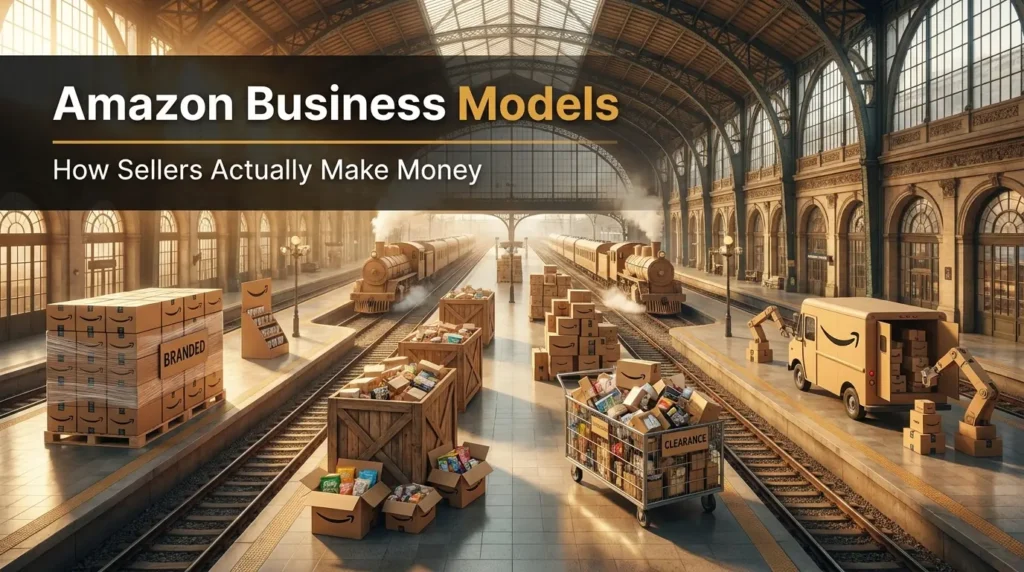
Amazon Business Models Explained: How Sellers Actually Make Money
TL;DR
There are six main Amazon business models: private label, wholesale, retail arbitrage, online arbitrage, dropshipping, and handmade, plus the 1P vendor route. Private label has the highest margin ceiling (20 to 35% net) but the slowest ramp. Wholesale is the most predictable. The right model is the one whose cost structure and cash flow match your capital and risk tolerance.
Most sellers do not fail on Amazon because demand dried up. They fail because they picked an Amazon business model whose cost structure they never understood. The model you choose decides your margins, your cash flow, and how fast you can scale before the whole thing gets fragile.
I have watched hundreds of sellers make this call. The ones who win treat the model as a strategic decision, not a vibe. Let me break down every option, the real economics behind each, and how to pick.
Jump to the section you need:
What are Amazon business models?
Amazon business models are the different ways sellers source, sell, and fulfill products on the marketplace. Each one carries its own startup cost, margin profile, and scaling ceiling. Two sellers can post the same revenue and end up with completely different businesses, because the underlying model, not the execution, sets the ceiling.
The models split into two camps. Reselling models (wholesale, retail arbitrage, online arbitrage, dropshipping) move products that already exist on Amazon. Brand-building models (private label, handmade) create something new that you own outright.
Key takeaway
Jungle Scout data shows roughly 67% of sellers run private label and 26% run wholesale (many do both). Popularity is not the same as fit. The model that makes money is the one where you can actually track and control cost at the SKU level.
The six Amazon business models
Here is what each model actually is, and where the money leaks.
1. Private label
You source a generic product from a manufacturer, put your own brand on it, and own the listing outright. This is the highest-ceiling model on Amazon. Well-run private label brands run net margins of 20 to 35% after fees, cost of goods, and ad spend.
The catch: PPC is not optional. Most private label ASINs need ads to hold rank, so your margin is exposed to rising ad costs. Upfront investment is heavy, and most sellers do not break even in the first three months. Get your inventory math wrong here and you either stock out at launch or bury cash in dead stock. This is where tight safety stock and reorder point discipline pays for itself.
2. Wholesale
You buy branded products in bulk from authorized distributors and resell existing ASINs. Margins are thinner than private label, but costs are far more predictable and ads are usually minimal. You will fight for the Buy Box against other sellers on the same listing, so price and fulfillment speed decide who wins.
Wholesale scales fast across many SKUs because you skip product development. The constraint is operational: getting authorized accounts, managing purchase orders, and keeping inventory turnover high enough that thin margins still generate real cash.
3. Retail arbitrage
You buy discounted or clearance products from physical stores and resell them on Amazon. Startup cost is low and you can make a first sale within a week. The problem is scale: every unit requires you to physically find it, so revenue is capped by your legs and your time. It is a cash-flow starter, not a business you sell later.
4. Online arbitrage
Same idea as retail arbitrage, but you source from online retailers instead of driving to stores. It scales a little better because sourcing can be partly delegated or tooled. Margins stay thin and gating on popular brands is a constant headache.
5. Dropshipping
You list products you do not hold and have a supplier ship directly to the customer. Capital-light, but the hardest to run cleanly on Amazon. Amazon requires you to be the seller of record on packing slips, and slow supplier fulfillment torches your metrics fast. Margins are the thinnest of any model.
6. Handmade
You make original products yourself and sell through Amazon Handmade. High margins per unit, strong brand story, but capacity is capped by how much you can physically produce. Great for craft businesses, tough to scale past a certain point.
Startup cost and margin comparison
Numbers make the tradeoffs obvious. These are typical ranges, not guarantees.
| Model | Startup cost | Time to first sale | Net margin | Scalability |
|---|---|---|---|---|
| Private label | $2,000 to $7,000+ | 3 to 6 months | 20 to 35% | Very high |
| Wholesale | $2,000 to $5,000+ | 4 to 8 weeks | 10 to 20% | Very high |
| Online arbitrage | $500+ | 2 to 4 weeks | 10 to 15% | Medium |
| Retail arbitrage | $500+ | 1 to 2 weeks | 10 to 20% | Low |
| Dropshipping | $100 to $500+ | 1 to 3 weeks | 5 to 10% | Medium |
| Handmade | $100 to $1,000 | 1 to 4 weeks | High per unit | Low |
Watch out
A 30% gross margin can turn into a 4% net once PPC, returns, and storage fees hit. If you cannot see profit at the SKU level, you are flying blind no matter which model you pick.
Amazon 1P vs 3P: two different games
Every model above is a third-party (3P) approach: you sell through Seller Central and Amazon takes a referral fee. Third-party sellers now account for roughly 60% of units sold on Amazon, and Amazon booked over $140 billion in third-party services revenue in a recent year, per its own filings.
The first-party (1P) route is different. As a 1P vendor you sell your inventory wholesale to Amazon itself through Vendor Central, and Amazon resells it to shoppers. You give up pricing control and margin in exchange for the “Ships from and sold by Amazon” badge and volume. Vendor Central is invite-only, so most sellers build on 3P first and treat 1P as an option that shows up later.
How to choose the right model
Start with three honest inputs: your capital, your risk tolerance, and how much time you can put in. Then match.
- Under $1,000 and learning: arbitrage or dropshipping to understand the mechanics without big risk.
- $3,000+ and want predictable cash flow: wholesale.
- $5,000+ and building a sellable asset: private label.
- A product only you can make: handmade.
Whichever you choose, the winning habit is the same: track profit and inventory at the SKU level from day one. The sellers who scale know their reorder points, their order quantities, and their IPI score cold. The ones who grind know their revenue and nothing else. For the deeper reasons a model can quietly break even at gross and bleed at net, our guide on FBA excess inventory is worth a read.
For the official rules on each fulfillment path, Amazon’s Seller Central resources are the source of truth.
Frequently asked questions
Which Amazon business model is most profitable?
Private label has the highest margin ceiling, typically 20 to 35% net for well-run brands, but it also carries the most upfront risk and the longest ramp. Wholesale offers lower but more predictable margins. The most profitable model in practice is the one whose cost structure you can control.
What is the difference between an FBA seller and a wholesale seller?
FBA describes fulfillment (Amazon stores and ships your inventory) and can be used with almost any model. Wholesale describes sourcing (buying branded goods in bulk to resell). Most wholesale sellers use FBA, so the terms overlap but answer different questions: how you get product versus how it ships.
Can I switch Amazon business models later?
Yes. Many sellers start with arbitrage to learn, move to wholesale for cash flow, then launch private label to build equity. Just re-run your cost and cash-flow math before each switch, because the model that fit at $5k a month may not fit at $50k.
Pick the model, then run it like a business
No Amazon business model wins on its own. The seller who tracks cost, forecasts demand, and never stocks out beats the one chasing the “best” model every time. Profit Hawk gives Amazon sellers the inventory forecasting and replenishment signals to run any of these models without drowning in spreadsheets. Start your free trial of Profit Hawk and put your inventory on autopilot.

15+ years in the Amazon selling world, helping hundreds of brands figure out inventory without losing their minds. I built Forecastly, which became the go-to tool for Amazon inventory forecasting before Jungle Scout acquired it. After leading Product and Design at Jungle Scout for several years, I missed being close to the real problems sellers face. In 2025, I kept hearing the same thing: inventory tools were too complex, too expensive, or just didn't fit. So I built Profit Hawk.